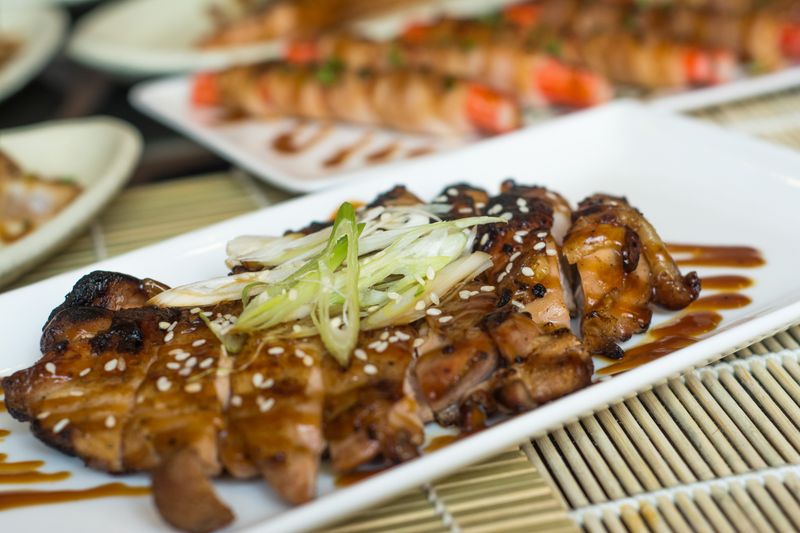
In Japan, "teriyaki" names a cooking method before it names a bottled product. The word combines teri, the glossy sheen a glaze leaves on food, with yaki, meaning grilled or broiled. That distinction matters, because a home cook holding a supermarket bottle labeled "teriyaki sauce" is usually working with something related to, but not identical to, the technique the word originally described. This guide traces how teriyaki developed as a glazing method in Japanese cooking, how it changed after reaching North American kitchens and menus, and how to build a from-scratch version at home that leans closer to the original technique than to the bottle.
What teriyaki originally meant in Japan
As a technique, teriyaki refers to repeatedly brushing food with a soy-based glaze while it grills or broils, building up layers of shine and caramelized flavor in stages rather than applying a sauce once at the end. It belongs to a broader family of Japanese glazing and simmering methods that use soy sauce, mirin, and sugar in varying ratios; a close relative is nitsuke, a simmered rather than grilled preparation. Fish — particularly yellowtail, mackerel, and eel — and chicken are the most common traditional subjects, chosen partly because their fat content helps the glaze set without the surface drying out under repeated passes of heat.
The core ratio: soy sauce, mirin, sake, and sugar
A traditional teriyaki glaze is built from four ingredients, each doing a specific job. Soy sauce supplies salt and umami depth and gives the glaze its color. Mirin, a sweet rice wine, contributes sweetness along with the glossy finish that gives the technique its name. Sake adds aroma and a layer of flavor that plain water or stock cannot replicate. A small amount of sugar rounds out the sweetness and helps the glaze caramelize at the edges without needing excessive mirin. Ratios vary by region and household, but a common starting point is roughly equal parts soy sauce and mirin, with sake and sugar added in smaller amounts to taste. None of these ingredients does the same job as another, which is why simply swapping in bottled "teriyaki marinade" for soy sauce in an unrelated recipe tends to produce a flatter result.
How the glazing technique actually works
The defining feature of teriyaki as a technique is repetition under direct heat. The protein is brushed with the soy-mirin-sake-sugar mixture, grilled or broiled briefly, brushed again, and returned to the heat — often four or five times in a single cooking session. Each pass reduces a thin layer of liquid clinging to the surface, concentrating sugars and building the glaze's characteristic shine and slightly sticky exterior. This is fundamentally different from simmering a protein in a pool of sauce, which produces a wetter, saucier result closer to nitsuke than to teriyaki proper. The grilling heat is also doing real work: it caramelizes the sugars in the glaze at the surface, which a pan simmer at lower, gentler heat does not achieve to the same degree.
How teriyaki changed after reaching North America
Japanese restaurants that opened in the United States through the twentieth century introduced teriyaki to a wider audience, and the dish adapted as it spread. Portions grew larger, sauces were often sweetened further to suit a broader palate, and teriyaki increasingly appeared as a glossy coating over whole cutlets or stir-fried vegetables rather than as a technique applied in stages. From there it became a flavor category rather than a specific cooking method — something closer to "soy-sweet glaze" than to the grilling process it began as. None of this makes the American-style version lesser or illegitimate; it is a different, equally real tradition that grew out of migration, restaurant adaptation, and the commercial food industry, and it deserves to be understood on its own terms rather than measured only against its origin.
Bottled teriyaki sauce vs a from-scratch glaze
Commercial bottled teriyaki sauce is formulated for shelf stability and a thick, cling-to-the-spoon texture, which usually means added thickeners such as modified starch or xanthan gum, along with preservatives and often a higher sugar load than a home-reduced glaze needs. A from-scratch version built on the traditional ratio gets its body entirely from reduction — simmering off water until the sugars and soy solids concentrate naturally — which gives a thinner, glossier result with a more pronounced soy and rice-wine flavor instead of a uniform sweetness. Neither version is a mistake; they are built for different purposes, one for a long shelf life and consistent texture across batches, the other for immediate use and a closer echo of the grilling technique.
Building a from-scratch teriyaki glaze at home
A basic home version combines soy sauce, mirin, a smaller amount of sake, and sugar in a small saucepan, brought to a gentle simmer and reduced until it thickens slightly and coats a spoon. For a dish closer to the traditional technique, that glaze is then brushed onto chicken thighs, salmon, or another fatty protein in stages under a broiler or on a grill, letting each layer set and caramelize before adding the next. This is a home cook's interpretation of the technique, built with ordinary kitchen equipment rather than a professional grill, and it is worth treating it as exactly that — a reasonable approximation, not a claim of matching a specific regional or restaurant version.
Choosing proteins and vegetables that take a glaze well
Fattier cuts hold up best to repeated glazing because the fat buffers the surface against drying out between brushings. Chicken thighs, salmon, and eggplant are reliable choices; lean chicken breast or thin fish fillets tend to dry out or overcook by the time the glaze has built up properly. Vegetables such as eggplant, shishito peppers, or green beans can be glazed the same way over lower heat, since their sugars caramelize faster than a dense protein's surface does.
| Attribute | Bottled teriyaki sauce | Home-reduced glaze |
|---|---|---|
| Thickener | Often modified starch or gum | Natural reduction only |
| Sweetness level | Usually higher, standardized | Adjustable, often lighter |
| Shelf life | Months unopened | About a week refrigerated |
| Best use | Quick marinade or stir-fry sauce | Staged glazing under direct heat |
Common mistakes
- Treating teriyaki sauce purely as a marinade and never brushing it on again during cooking, which skips the glazing step that gives the dish its name.
- Cooking over heat that is too high the whole time, which burns the sugars in the glaze before the center of the protein finishes cooking.
- Substituting dark or thick soy sauce for regular soy sauce without adjusting the amount, which throws off the salt balance.
- Reducing the glaze far in advance and letting it sit, so it turns gluey and overly sticky by the time it reaches the pan or grill.
Frequently asked questions
- Is bottled teriyaki sauce "real" teriyaki?
- It is a real, widely used product, just one that developed along a different path than the traditional grilling technique. Both are legitimate; they are simply built for different purposes.
- Can I use teriyaki glaze as a marinade?
- Yes, briefly, but it works best as a finishing glaze applied in stages during cooking rather than as a long soak beforehand.
- What can I use if I don't have mirin?
- A mix of dry sherry or rice vinegar with a little extra sugar can approximate mirin's sweetness, though the flavor will be noticeably different.
- Does a home version need sake?
- No. Sake adds aroma and depth, but a glaze made without it still works; the flavor will simply be slightly flatter.
Sources: documented culinary history sources on Japanese glazing and grilling techniques; published culinary technique references on soy-based sauce reduction methods.