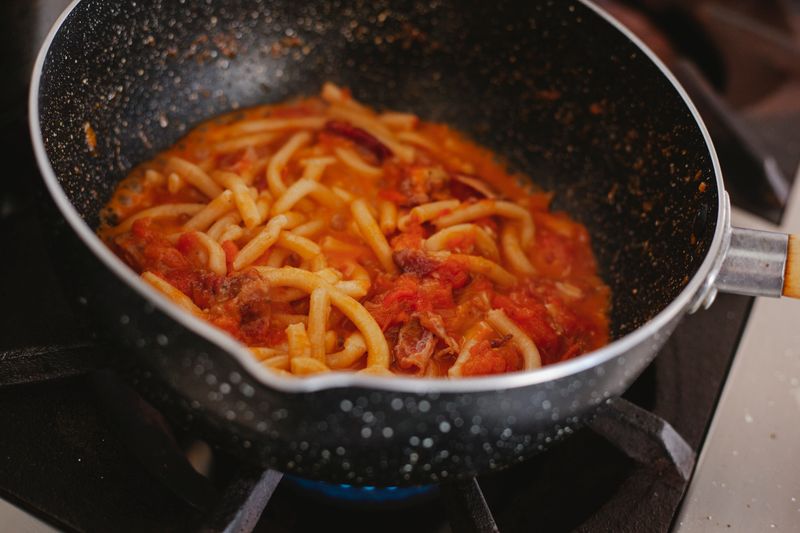
Reduction is one of the simplest tools in the kitchen and one of the most powerful. No new ingredient is added; a liquid is simply simmered until some of its water boils away, and what is left behind tastes and feels completely different from where it started. A thin, watery pan sauce becomes glossy and clingy. A sharp, raw red wine becomes rounded and almost sweet. A pot of stock becomes a base strong enough to carry an entire dish on its own. Recipes often give a reduction time, but pan thickness, stove output, and starting volume vary so much from kitchen to kitchen that the timer is only ever a rough guide. Learning to judge a reduction by sight, sound, and feel is the skill that actually makes the technique reliable.
What Happens When You Reduce a Sauce
A sauce, stock, or sweet syrup is mostly water carrying dissolved flavor compounds, sugars, proteins, and sometimes fat. When that liquid simmers, the water evaporates as steam, but the flavor compounds, sugars, and proteins do not evaporate with it; they stay behind in a shrinking volume of liquid. The practical effect is concentration: the same amount of flavor is now packed into less liquid, so every spoonful tastes stronger. At the same time, dissolved proteins and natural gums thicken slightly as they become more concentrated, and any residual sugar becomes more pronounced, which is why a reduced wine sauce or balsamic glaze tastes noticeably rounder and less sharp than the liquid it started as. Reduction does not just make a sauce taste stronger; it also changes its texture and balance.
Choosing the Right Pan and Heat
A wide, shallow pan reduces liquid much faster than a narrow, deep pot holding the same volume, because evaporation happens at the surface and a wider pan exposes more surface area. For a quick pan sauce, a wide skillet is the right choice. For a stock that needs to reduce by half over a long period without reducing too aggressively or scorching at the edges, a heavier pot with slightly lower heat gives more control. A hard boil moves liquid out of the pan fast but risks scorching anything with sugar or protein clinging to the bottom, especially cream-based or sugar-based liquids. A gentle simmer takes longer but is far more forgiving and lets you taste and adjust as you go, which matters more than speed in almost every home-cooking situation.
Judging Doneness Without a Timer
Because every stove, pan, and starting volume is different, the most reliable way to know a reduction is ready is to watch how it behaves rather than how many minutes have passed.
| Liquid being reduced | Visual or physical cue | What it tells you |
|---|---|---|
| Stock or broth | Bubbles slow down and liquid clings briefly to the back of a spoon | Proteins and gelatin have concentrated enough to add body |
| Wine or vinegar-based sauce | Sharp, raw smell fades and aroma turns rounder | Much of the harsh alcohol or acidity has cooked off |
| Cream sauce | Surface bubbles get larger and the sauce coats a spoon instead of running off | Water content has dropped enough for the sauce to hold a coating |
| Fruit or sugar syrup | Bubbles become slower and larger, syrup looks slightly stickier | Sugar concentration is rising toward the glaze stage |
| Pan sauce with drippings | Volume visibly drops by roughly half and color deepens | Flavor has concentrated enough to coat meat or vegetables properly |
Reducing Stocks vs Wine vs Cream
Not every liquid reduces the same way, so the approach should change with the ingredient. Stock relies on gelatin and collagen released from bones and connective tissue; reducing it concentrates that gelatin, which is why a well-reduced stock feels noticeably thicker even with no starch added at all. Wine and vinegar reductions are mostly about driving off sharp, volatile aromas and leaving behind sugar and acid in better balance, which is why a harsh young wine can taste surprisingly pleasant once reduced by half or more. Cream reductions behave differently again: cream contains fat and milk proteins that thicken as water cooks away, but cream can also break or separate if it reduces too hard and too fast, so a gentler simmer and more frequent stirring matter more with dairy than with stock or wine.
Seasoning Before and After Reduction
Salt, like every other dissolved component, becomes more concentrated as a liquid reduces. A sauce seasoned to taste at the start can turn unpleasantly salty by the time it has reduced by half, especially with stocks or sauces built on soy sauce, fish sauce, or other salty bases. The safer approach is to season lightly at the beginning, mainly to support the cooking process, and then taste again near the end once the reduction is close to its final volume, adjusting salt, acid, and sweetness only at that point. The same caution applies to strong aromatics like garlic or chili, whose flavor also intensifies as the liquid around them shrinks.
Common mistakes
- Trusting a recipe's stated reduction time instead of watching the liquid's actual behavior.
- Seasoning fully with salt before reducing, then ending up with an oversalted sauce.
- Using a narrow pot for a quick pan sauce, which slows evaporation far more than expected.
- Boiling a cream-based sauce too hard, causing it to separate instead of thickening smoothly.
- Walking away during the final stage of a reduction, when a sauce can go from perfect to scorched in a minute or two.
- Reducing a sauce that already contains a starch thickener, which can overthicken or turn gluey if reduced further on top of that.
Frequently asked questions
- How do I know when a sauce has "reduced enough"?
- Look for a visible drop in volume, slower and larger bubbles, and a texture that coats a spoon or the back of a utensil rather than running off it immediately. Taste at this point; if the flavor is concentrated but not yet overpowering, it is usually ready.
- Can I speed up a reduction without ruining it?
- Using a wider pan is the safest way to speed up reduction, since it increases evaporation without raising the heat to a point where the bottom can scorch. Raising the heat too aggressively on a narrow pot often causes burning before the liquid actually reduces.
- Why did my cream sauce curdle while reducing?
- Cream sauces can separate when boiled too hard or too long, especially if they contain acidic ingredients like wine or tomato. Reducing cream gently, over moderate heat, with occasional stirring, keeps the fat and proteins suspended instead of breaking apart.
- Does reduction remove alcohol from a wine-based sauce?
- Reduction lowers the alcohol content significantly but does not remove all of it, even after a long simmer. Some residual alcohol typically remains, so wine reductions should not be treated as entirely alcohol-free.
- Is it better to reduce before or after adding butter or cream to a pan sauce?
- Most pan sauces reduce their main liquid, such as wine or stock, first to concentrate flavor, then finish with butter or cream off the heat or over very gentle heat. Reducing hard after dairy or butter is added raises the risk of separation.
Sources: published culinary technique references, general food-science explanations of flavor concentration and evaporation, professional kitchen training materials.