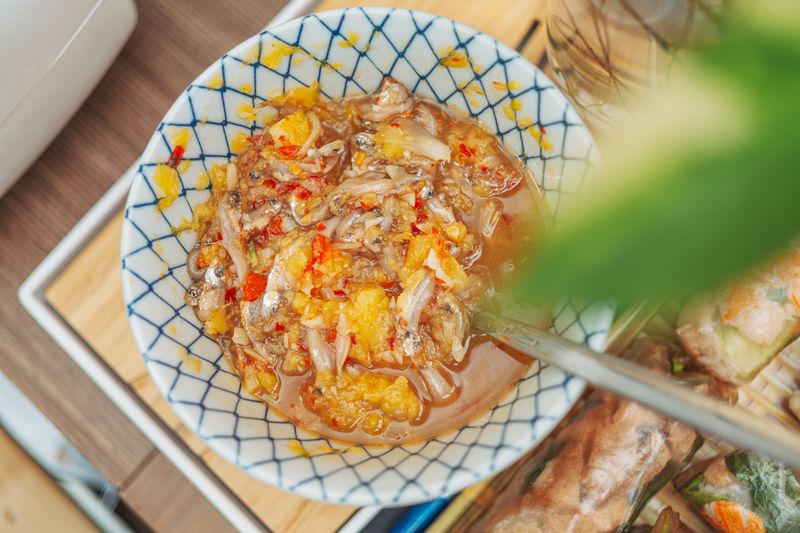
Nuoc cham is a Vietnamese dipping sauce built from fish sauce, lime juice, sugar, water, garlic, and chile, used across an enormous range of dishes — spring rolls, grilled meats, rice noodle bowls, and more. Its defining feature isn't a fixed recipe but a balance: sweet, sour, salty, and hot elements held in proportion to one another, adjusted dish by dish rather than applied the same way every time. Understanding that balance, rather than memorizing one ratio, is what lets a cook adapt nuoc cham correctly to whatever it's served alongside.
What nuoc cham is built from
The base ingredients are fish sauce (for salt and savory depth), fresh lime juice (for sourness), sugar (for sweetness, usually dissolved into the liquid first), water (to dilute the fish sauce's intensity), and fresh chile and garlic, typically minced and left in the sauce rather than strained out. Some versions add grated carrot or daikon for texture and a mild sweetness. The sauce is almost always made fresh rather than stored for long periods, since the garlic and chile continue to intensify over time and the lime juice loses its brightness.
The four-way balance that defines the sauce
Nuoc cham is often described by its four core tastes working against each other: fish sauce brings salt and umami, sugar brings sweetness, lime brings acidity, and chile brings heat. No single element is meant to dominate; the sauce is balanced when none of the four stands out on its own, and the overall effect reads as bright and savory rather than as any one specific flavor. This is different from many Western dipping sauces, which are often built around one dominant flavor with supporting notes — nuoc cham's identity is the balance itself.
Why the ratio changes by dish
A sauce meant to dress a bowl of vermicelli noodles with grilled pork needs to be diluted enough to coat the noodles without overwhelming them, since it's often poured generously over the whole bowl. A sauce meant purely for dipping spring rolls can be more concentrated, since only a small amount touches the food at a time. Grilled meats and seafood often call for a version with a bit more chile and garlic, since the sauce needs to stand up to char and smoke. None of these are separate sauces — they're the same base, adjusted by how much of it the dish will absorb and what it needs to balance.
Building it step by step
A common approach dissolves sugar into warm water first, then adds fish sauce, then lime juice, tasting after each addition rather than combining everything at once. Garlic and chile are added last, minced finely enough to distribute through the liquid without clumping. Tasting in this order — sweet and salty first, sour next, heat last — makes it easier to identify which element is missing if the sauce tastes off, rather than guessing at the whole mixture.
Adjusting a sauce that's out of balance
If the sauce tastes flat, it usually needs more lime juice rather than more fish sauce, since sourness is what makes the other flavors register. If it tastes harsh or overly fishy, more sugar and a splash of water usually rounds it out faster than adding more of anything else. If it's too sweet, a small addition of lime juice or a pinch more fish sauce rebalances it without starting over. This kind of small, incremental adjustment is more reliable than trying to calculate an exact ratio in advance, since fish sauce brands vary significantly in saltiness and limes vary in juice yield.
Adjusting nuoc cham by dish
| Dish | Dilution | Adjustment |
|---|---|---|
| Fresh spring rolls (gỏi cuốn) | More concentrated | Less water, since only a small amount is used per bite |
| Vermicelli noodle bowls (bún) | More diluted | More water, since the sauce coats the whole bowl |
| Grilled meats and seafood | Moderate | Extra garlic and chile to stand up to smoky, charred flavor |
| Fried foods (spring rolls, fritters) | Moderate to concentrated | Extra acidity to cut through the oil |
Common mistakes
- Using bottled lime juice instead of fresh, which tastes flatter and less bright.
- Adding all ingredients at once instead of tasting in stages, making it hard to isolate what's missing.
- Making the sauce too far ahead of time, letting the garlic and chile turn harsh and overpowering.
- Using the same concentration for every dish, rather than adjusting dilution for how the sauce will be used.
- Oversalting by adding fish sauce without accounting for how much saltier some brands are than others.
Frequently asked questions
- Can I make nuoc cham ahead of time?
- It's best made close to serving. The sauce can hold for a day refrigerated, but garlic and chile intensify over time and lime juice loses brightness, so freshly made is usually noticeably better.
- What can I use instead of fish sauce?
- There isn't a true substitute, since fish sauce provides both salt and a specific savory depth, but some cooks use a vegetarian fish sauce alternative made from fermented soy or pineapple for a plant-based version with a different but comparable base.
- Why does my nuoc cham taste too fishy?
- This usually means it needs more sugar, lime juice, and water to balance the fish sauce's intensity, rather than less fish sauce outright.
- Is nuoc cham the same as nuoc mam?
- No. Nuoc mam refers to fish sauce itself, the single ingredient. Nuoc cham is the finished dipping sauce made by combining fish sauce with lime, sugar, water, garlic, and chile.
Sources: documented culinary history sources on Vietnamese dipping sauce traditions and regional variation; general culinary reference materials on balancing sweet, sour, salty, and spicy flavor components.