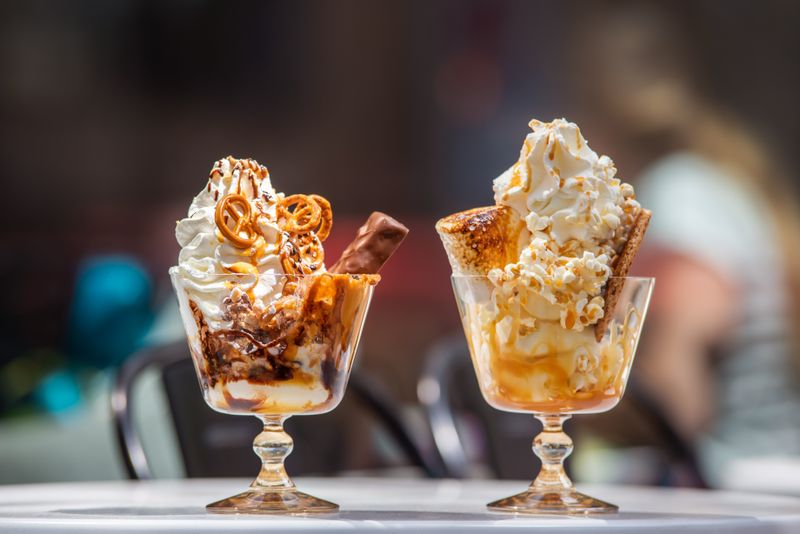
A sundae lives or dies on contrast. The ice cream itself is cold, smooth, and soft; a good topping should do something different — pour, cling, crack, or crunch — rather than just repeat that same softness in a different flavor. The most useful way to plan a sundae isn't by flavor pairing alone but by what each topping's texture does once it meets cold ice cream, since cold temperature changes how sauces behave far more than most people expect. This guide ranks common toppings by that behavior, from thin pourable sauces to toppings that add crunch.
Why cold changes a topping's texture
Almost every sauce thickens as it cools, and ice cream is cold enough to accelerate that shift within seconds of contact. A sauce that looks perfectly pourable warm can seize into a stiff, barely spreadable layer the moment it touches a scoop straight from the freezer. This is why sundae sauces are usually served warm or at room temperature rather than cold, and why the "ranking by texture" in this guide is really a ranking by how fast and how much each topping firms up on contact.
Tier one: thin, pourable sauces
Chocolate syrup and thin fruit syrups stay the most fluid on cold ice cream because they're built from a sugar-water base rather than fat or dairy, and sugar syrups don't firm up with cold the way butter- or cream-based sauces do. These are the toppings to reach for when you want the sauce to pool at the base of the dish and soak slightly into the lower scoops rather than sit on top.
Tier two: sauces that thicken but stay soft
Caramel sauce, butterscotch sauce, and dulce de leche all contain butter or cream, which means they firm up noticeably on contact with cold ice cream but don't go brittle — they go from pourable to a soft, pliable ribbon. This tier is the most forgiving for drizzling, since the thickening actually helps the sauce hold its shape on top of a scoop instead of running straight down the sides.
Tier three: sauces built to set hard (magic shell style)
Chocolate-and-coconut-oil shell toppings are formulated specifically to firm up into a thin, crackable shell within about a minute of contact with frozen ice cream. This is a deliberate texture effect, not a flaw: the coconut oil (or similar fat) solidifies at a higher temperature than the ice cream's surface, so it sets almost immediately. These toppings should be poured just before serving, since the shell effect depends on the ice cream being properly frozen underneath it.
Tier four: textured mix-ins and crunch
Chopped nuts, crushed cookies, toasted coconut, and candy pieces don't change texture much from the cold at all — their job is pure contrast, adding crunch against the smoothness of the ice cream and the softness of a sauce. These are best added last and in a thin, even scatter rather than a pile, so every bite gets a little crunch instead of some bites getting none and others getting too much.
Tier five: whipped and airy toppings
Stabilized whipped cream holds its shape at room temperature and softens only slightly against cold ice cream, making it the most texturally stable component of a sundae if it's been properly stabilized. Unstabilized whipped cream, by contrast, can deflate and turn watery within a few minutes next to a cold scoop, especially in a warm room, which is the main argument for stabilizing it when a sundae needs to sit for a photo or a buffet table.
A quick texture-pairing checklist
- Want the sauce to pool and soak in: use a thin syrup, like chocolate syrup or a fruit syrup.
- Want a soft ribbon that holds its shape on top: use caramel, butterscotch, or dulce de leche.
- Want a crackable shell: use a magic-shell style chocolate topping, poured right before serving.
- Want contrast and crunch: add chopped nuts or crushed cookies last, in a thin scatter.
- Want a topping that survives sitting out: use stabilized whipped cream, not a plain unstabilized version.
Toppings compared at a glance
| Topping | Behavior on cold ice cream | Best use |
|---|---|---|
| Chocolate syrup | Stays thin, pools and soaks in | Base layer under other toppings |
| Caramel / butterscotch / dulce de leche | Thickens into a soft ribbon | Drizzled on top, holds shape |
| Magic-shell chocolate | Sets into a hard, crackable shell | Poured just before serving |
| Chopped nuts or cookies | Unchanged, adds crunch | Scattered last, in a thin layer |
| Stabilized whipped cream | Holds shape, softens slightly | Topping that needs to sit before eating |
Common mistakes
- Pouring a thick sauce straight from the refrigerator, which seizes up before it can spread evenly over the scoop.
- Adding a magic-shell topping too early, before serving, so the shell sets before anyone eats the sundae.
- Piling crunchy toppings in one spot instead of scattering them, so only a few bites get any texture contrast.
- Using unstabilized whipped cream on a sundae meant to sit for more than a few minutes.
Frequently asked questions
- Why does warm sauce work better than cold sauce on ice cream?
- Warm sauce stays pourable long enough to coat the scoop evenly; sauce that's already cold or thick seizes on contact and tends to sit in a clump instead of spreading.
- What makes a "magic shell" topping harden?
- It's typically chocolate mixed with a fat, often coconut oil, that solidifies at a warmer temperature than the ice cream's surface, so it sets almost immediately on contact.
- Should crunchy toppings go on before or after the sauce?
- After, in most cases. Adding them after the sauce means they sit on top rather than getting buried and softened by the sauce underneath.
- How do I keep whipped cream from melting on a sundae?
- Stabilize it with gelatin or cornstarch before piping it on, and add it as close to serving time as practical.
Sources: general food science references on fat solidification temperatures and sugar syrup behavior at cold temperatures; standard pastry and confectionery technique references on stabilized whipped toppings.