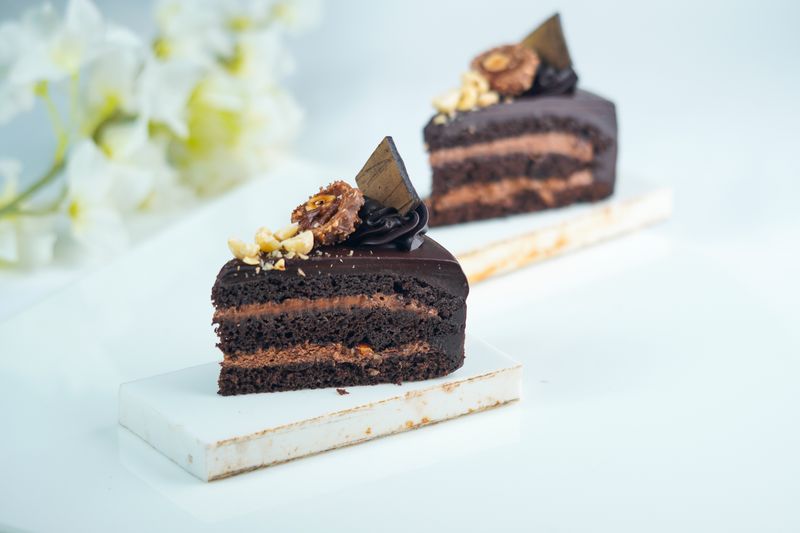
Ganache is only ever two ingredients — chocolate and cream — which makes it one of the simplest mixtures in dessert making and, at the same time, one of the most versatile. The reason a single mixture can become a glossy cake glaze, a firm truffle center, or a light, pipeable frosting is entirely down to proportion. Change the ratio of chocolate to cream, and you change how much the mixture firms up as it cools, which determines whether it pours, holds a shape cut with a knife, or whips into something airy. Once you understand the ratio logic, you stop needing three separate recipes and start needing one formula you adjust on purpose.
What ganache actually is
Ganache forms when hot cream is poured over chopped or small-pieces chocolate, left briefly to let the heat melt the chocolate, then stirred or whisked into a smooth emulsion. The cream's fat and water disperse the melted chocolate's cocoa solids and cocoa butter into a stable mixture rather than a separated, greasy puddle. As ganache cools, the cocoa butter in the chocolate re-solidifies and the mixture firms up; how much it firms up depends almost entirely on how much chocolate is in the mixture relative to cream, because chocolate is the only ingredient contributing solid structure at room temperature.
The ratio logic: more chocolate means more structure
Think of the ratio as a dial rather than three unrelated recipes. A ganache that is mostly cream with a little chocolate stays soft and pourable even cold, because there isn't enough solid cocoa butter to lock the mixture in place. A ganache that is mostly chocolate with a little cream sets up firm enough to slice, roll into truffles, or hold a stamped shape. Everything between those extremes is a gradient, not a set of fixed categories, so recipes that look different are often the same technique at different points on that gradient.
Pourable glaze: the loosest ratio
A glaze meant to pour over a cake or tart and set into a thin, glossy shell uses close to equal parts chocolate and cream by weight, sometimes slightly more cream for extra-dark chocolate. This ratio stays fluid enough to pour at a warm room temperature and thin enough to coat evenly without pooling into thick ridges at the edges. Pouring it slightly warm, over a cake set on a rack with a tray underneath to catch drips, gives the smoothest, most even shell.
Firm filling and truffle centers: the richest ratio
A ganache meant to be cut into squares, rolled into truffle centers, or piped into a tart shell as a stable filling needs roughly twice as much chocolate as cream by weight. This higher ratio sets firm enough at room temperature to hold a cut edge and firm enough refrigerated to roll between your palms without melting instantly. It is also the base most people reach for when they want a ganache that can be formed by hand once it has rested.
Whippable frosting: cooling before whipping, not during mixing
Whipped ganache frosting starts from a softer ratio — close to one part chocolate to two parts cream — stirred smooth, then cooled fully, often overnight in the refrigerator, before being whipped with a mixer the way you'd whip plain cream. The whipping incorporates air, lightening the texture into something spreadable and pipeable rather than dense. Whipping a ganache that's still warm just makes a melted mess; the mixture has to be genuinely cold and partially set before beating introduces air properly.
Adjusting the ratio for milk and white chocolate
The ratios above assume standard dark chocolate. Milk and white chocolate contain less cocoa solid and more sugar and milk fat, so they set up softer at the same ratio dark chocolate would use. A glaze or filling made with milk chocolate typically needs a bit more chocolate relative to cream to reach the same firmness, and white chocolate ganache often uses close to three parts chocolate to one part cream just to set at all. Treat the dark-chocolate ratios as a starting point and firm up from there if a milk or white chocolate version stays too soft.
Ratio reference by use
| Use | Chocolate : cream (by weight) | Texture at room temperature |
|---|---|---|
| Pourable glaze | 1 : 1 | Fluid, sets into a thin glossy shell |
| Firm filling or truffles | 2 : 1 | Cuttable, rollable, holds a shape |
| Whipped frosting (before whipping) | 1 : 2 | Soft, becomes airy once chilled and whipped |
| White chocolate ganache (any use) | Up to 3 : 1 | Needs more chocolate to match dark chocolate's set |
Common mistakes
- Using the same ratio for every use instead of adjusting it for glaze, filling, or frosting.
- Whipping ganache while it is still warm or only lightly chilled, which deflates instead of aerates it.
- Pouring cream over chocolate that's chopped too coarsely, leaving unmelted chunks in the finished glaze.
- Not adjusting the ratio when switching to milk or white chocolate, leading to a ganache that never firms up.
- Stirring ganache aggressively while it's still very hot, which can incorporate air bubbles into a glaze meant to stay glassy smooth.
Frequently asked questions
- Can I fix a ganache that set up too firm?
- Yes — gently warm it and stir in a little extra warm cream, a spoonful at a time, until it loosens to the texture you need.
- Can I fix a ganache that stayed too soft?
- Melt in a little more chopped chocolate, a small amount at a time, and let it cool again before judging the texture.
- Does the brand or cocoa percentage of chocolate change the ratio?
- Yes — higher cocoa percentages set up firmer, so a 70% dark chocolate ganache will firm up more than the same ratio made with a 55% chocolate.
- How long does ganache keep?
- Covered and refrigerated, ganache generally keeps about one to two weeks; let it come to room temperature or warm it gently before using it again.
Sources: published culinary technique references on emulsion-based chocolate mixtures and chocolate composition; professional pastry reference materials on ganache ratio conventions for glazing, filling, and whipped applications.