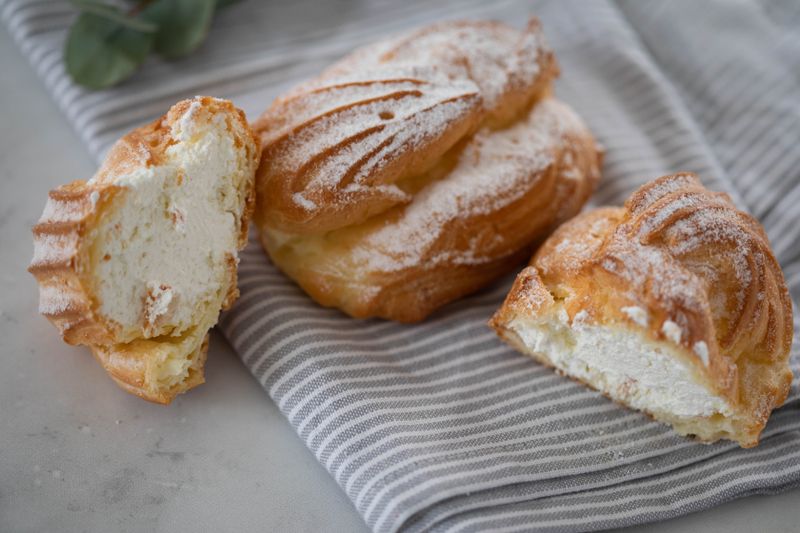
Pastry cream is the thick, custard-like filling behind éclairs, fruit tarts, Boston cream pie, and countless layered desserts, built from milk, egg yolks, sugar, and a starch that's cooked until it thickens into something sliceable enough to hold its shape in a pastry shell. It's a short ingredient list executed in a specific order, and almost every problem people run into — grainy specks of cooked egg, a thin or lumpy final texture, a skin forming on top as it cools — traces back to one of a few steps being rushed. This guide walks through the method in the order that actually prevents those problems, rather than just listing ingredients.
The base ratio: milk, egg, sugar, and starch
A standard pastry cream starts from milk as the primary liquid, egg yolks for richness and some thickening power, sugar for sweetness, and a starch — usually cornstarch or flour — as the main thickening agent. The starch is what lets pastry cream hold a firm, sliceable set once chilled, unlike a looser custard sauce that relies on egg alone. Vanilla or another flavoring is typically infused into the milk early, while it's still being heated, so the flavor distributes evenly rather than sitting on the surface.
Tempering the egg yolks: the step that prevents scrambling
The critical moment in pastry cream is combining hot milk with egg yolks without cooking the yolks into scrambled flecks. Tempering solves this by whisking a small amount of the hot milk into the yolks first, gradually raising their temperature, before whisking that warmed yolk mixture back into the rest of the hot milk. Added all at once, hot milk would cook the yolk proteins instantly and unevenly; added gradually, the yolks warm smoothly and stay suspended in the mixture instead of curdling.
Cooking out the starch completely
Once the tempered mixture is combined, it goes back on the heat and must be cooked until it visibly thickens and comes to a gentle boil, whisking constantly. This isn't just about reaching a thick texture — raw starch needs to reach a certain temperature to fully activate its thickening power and to lose a raw, chalky taste that undercooked pastry cream can have. Pulling it off the heat as soon as it looks thick, rather than letting it bubble gently for the extra minute it usually needs, is a common reason finished pastry cream turns out thinner than expected once it's fully chilled.
Cooling quickly to prevent a skin and bacterial growth
Hot pastry cream left to cool slowly on the counter forms a skin on top as the surface dries out, and it also spends longer in a temperature range where bacteria multiply quickly, both of which recipes try to avoid. Pressing plastic wrap directly against the surface of the warm pastry cream — rather than leaving an air gap over the top of the bowl — stops a skin from forming, and transferring it to a shallow container speeds up cooling by increasing the surface area exposed to the refrigerator's cold air.
Flavor variations built on the same base
Once the base technique is solid, flavoring is mostly a matter of infusing the milk differently: citrus zest, coffee, or crushed herbs like mint can steep in the hot milk before it's strained out, and melted chocolate can be stirred into the finished pastry cream while it's still warm for a chocolate version. The starch and egg ratio generally stays the same across these variations, since the thickening mechanics don't change — only what's infused or stirred in at the end does.
Loosening or lightening finished pastry cream
Pastry cream straight from the fridge is often too stiff to pipe or spread smoothly, so it's commonly whisked briefly to loosen it before use, or folded with a little whipped cream to make a lighter filling called crème diplomate. Both adjustments happen after the pastry cream has fully set and cooled — whisking warm pastry cream, or folding in whipped cream too early, just thins it out without giving the lighter texture that's the point of the adjustment.
Troubleshooting consistency
| Problem | Likely cause | Fix |
|---|---|---|
| Grainy specks | Egg yolks scrambled from untempered hot milk | Strain through a fine sieve; temper more slowly next time |
| Stays thin after chilling | Undercooked starch, pulled too early | Cannot be fixed after the fact; recook fully next time |
| Skin formed on top | Cooled uncovered or with an air gap | Press plastic wrap directly on the surface while still warm |
| Lumpy texture | Not whisked constantly while cooking | Whisk briefly or strain to smooth it out |
Common mistakes
- Pouring hot milk into egg yolks all at once instead of tempering gradually.
- Removing pastry cream from the heat as soon as it thickens, before the starch finishes cooking out.
- Leaving pastry cream to cool uncovered, which forms a skin on the surface.
- Whisking cold, set pastry cream too aggressively, which can break its structure and make it watery.
- Skipping a final strain, which leaves small lumps or egg flecks in an otherwise smooth filling.
Frequently asked questions
- Can I use whole eggs instead of just yolks?
- Whole eggs work but give a slightly less rich, slightly less yellow result; most classic recipes use yolks alone specifically for color and richness.
- Why did my pastry cream turn lumpy after chilling?
- It likely wasn't whisked constantly while cooking, letting small clumps of cooked starch form; straining the finished cream before chilling usually fixes this.
- How long does pastry cream keep in the fridge?
- Covered and refrigerated, it typically keeps for about two to three days; it's best used within that window since its texture can break down slightly after that.
- Can pastry cream be frozen?
- It's not recommended — the starch structure tends to separate and turn watery once thawed, even though the flavor stays fine.
Sources: published culinary technique references on custard and starch-thickened cream preparation; professional pastry reference materials on egg tempering and starch gelatinization temperatures.