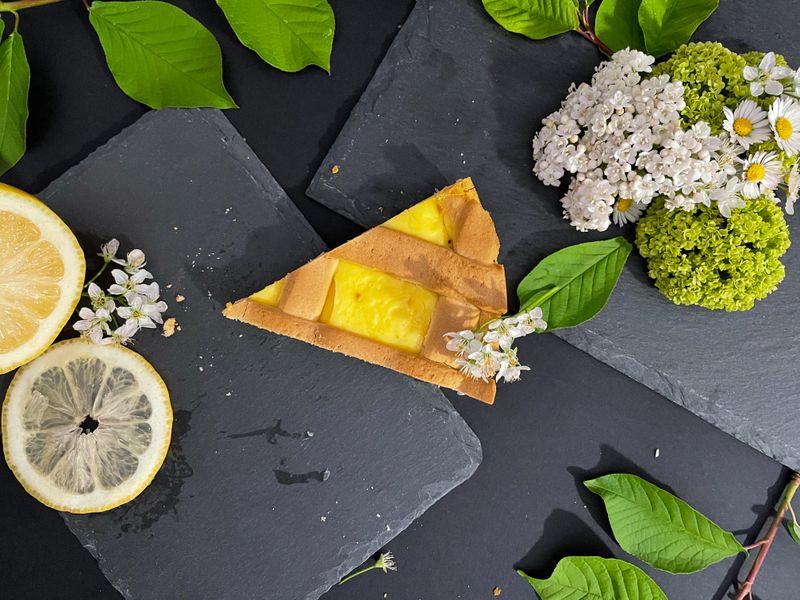
Lemon curd looks simple on paper — eggs, sugar, lemon juice, butter, cooked gently until thick — but it's one of the easier dessert sauces to push slightly off course. Too much heat and the eggs scramble into visible flecks; too little and it never sets past a thin syrup; too much egg relative to sugar and butter, and it tastes more like scrambled egg than citrus custard. This guide starts from a base ratio, then works through the specific symptoms and what each one points to.
The base ratio to start from
A reliable starting point is 1 cup of fresh lemon juice, 1 cup of sugar, 4 whole eggs (or a mix of whole eggs and extra yolks for a richer curd), and 6 tablespoons of butter, plus the zest of 2 lemons for aroma. That ratio gives enough egg protein to set the curd firmly without tasting eggy, enough sugar to balance the acidity, and enough butter to give it a glossy, rounded finish rather than a sharp, purely sour one.
The method that avoids most problems
Whisk the eggs, sugar, and lemon juice together in a saucepan off heat until combined, then cook over medium-low heat, stirring constantly, until the mixture thickens enough to coat a spoon and holds a line when you draw a finger through it on the back of the spoon. This usually takes 8 to 12 minutes of patient, constant stirring — not a quick boil. Remove from heat, stir in the butter a few pieces at a time until melted and glossy, then strain through a fine sieve to catch the zest and any small flecks of cooked egg before chilling.
Problem: the curd is grainy
Graininess almost always means part of the egg overcooked into small solid flecks, usually from heat that was too high or from stirring that paused at the wrong moment, letting egg touch the bottom of the pan directly. Straining the finished curd through a fine sieve removes the flecks that already formed, but preventing it next time means lower, steadier heat and a non-reactive, heavy-bottomed pan or a double boiler.
Problem: the curd is thin or never set
A curd that stays runny even after chilling was usually pulled off the heat too early, before the eggs reached the temperature where they actually thicken the mixture (roughly 170 to 180°F). It can also happen if the egg-to-liquid ratio was reduced too far, such as using only egg whites or too few eggs for the amount of juice. The fix for an undercooked batch is to return it to low heat, whisking constantly, until it visibly thickens; always test for the coats-a-spoon stage rather than going by time alone, since pan thickness and stove heat vary.
Problem: the curd tastes "eggy" rather than bright and citrusy
An eggy flavor usually means the eggs are overrepresented relative to sugar and lemon juice, or that the curd was cooked at too high a heat, which can give cooked egg a stronger, more dominant smell and taste. Keeping closer to the 1:1:1 ratio of juice, sugar, and eggs (by cup and count, not exact weight) and keeping the heat gentle both help the lemon stay the lead flavor.
Problem: the curd separated or looks greasy
This points to the butter, not the eggs. Butter added while the curd is still very hot, or added all at once instead of a few pieces at a time, can separate out into a slick layer instead of emulsifying into the curd. Whisking in cool butter gradually, off direct heat, usually brings a separated batch back together.
Troubleshooting at a glance
| Symptom | Likely cause | Fix |
|---|---|---|
| Grainy texture | Egg overcooked into small solid flecks | Strain through a fine sieve; lower the heat next time |
| Stays thin after chilling | Removed from heat before eggs set | Return to low heat, whisk until it coats a spoon |
| Tastes eggy | Too much egg relative to sugar and juice, or heat too high | Rebalance ratio next batch; cook gently |
| Greasy or separated | Butter added too hot or all at once | Whisk in cool butter a little at a time off heat |
Common mistakes
- Walking away from the pan while the curd cooks; constant attention is what prevents scrambled egg flecks.
- Judging doneness by time instead of by the coats-a-spoon test, since stoves and pans vary.
- Skipping the straining step, which is the easiest fix for small amounts of cooked egg.
- Using bottled lemon juice, which can taste flatter and sometimes more bitter than fresh juice.
Frequently asked questions
- Can I fix a batch that's already grainy?
- Straining it through a fine sieve while it's still warm removes most of the cooked egg flecks and salvages the texture for most uses.
- How long does homemade lemon curd keep?
- Refrigerated in a sealed container, it typically keeps for about one to two weeks. It does not freeze and thaw cleanly, since the texture tends to separate.
- Can I use a double boiler instead of direct heat?
- Yes, and it's the safer choice if you've had scrambling problems before, since it limits how hot the mixture can get.
- Why does my curd taste bitter?
- Bitterness usually comes from zest that included too much of the white pith underneath, which is more bitter than the colored peel itself.
Sources: standard pastry technique references on egg-thickened custards and curds; general food science material on egg coagulation temperatures and emulsification with butter.