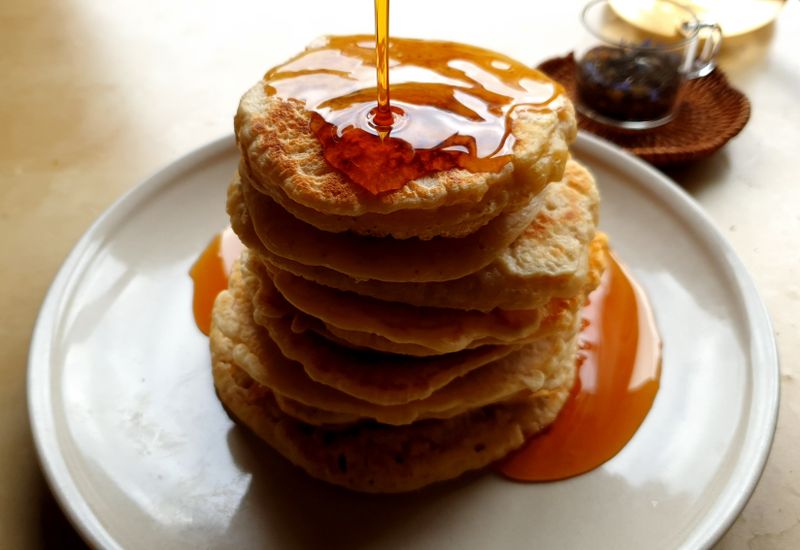
Most people choose a breakfast topping by habit, reaching for the same bottle of maple syrup no matter what is on the plate. But pancakes, waffles, oatmeal, yogurt, and French toast all behave differently once a sweet topping lands on them, and the right match depends less on flavor preference than on weight, texture, and how much free liquid the base food can absorb before it turns soggy or pools on the plate. This guide breaks breakfast foods down by those physical traits and matches them to syrups, compotes, and glazes that actually work with them, not just taste good in theory.
Why Weight and Texture Matter More Than Flavor Alone
A syrup's weight, meaning how thick or thin it pours, determines whether it soaks into a food or sits on its surface. A thin syrup, close to the viscosity of warm honey, spreads fast and seeps into anything porous, which is ideal for something like pancakes but a poor match for a food with no structure to absorb it, like plain yogurt, where it just slides to the bottom of the bowl. A thicker topping, such as a fruit compote with intact fruit pieces or a brown sugar glaze reduced to a syrupy coating, stays where it's placed. It clings to a spoon, sits in the ridges of a waffle, or coats the surface of oatmeal without disappearing into it. Matching a topping to a breakfast food starts with asking how much structure the food has to hold liquid, and only then considering sweetness or flavor.
Pancakes and Waffles: Surface Area Changes Everything
Pancakes and waffles look like the same food with a different shape, but their surfaces behave very differently under a topping. A pancake has a mostly flat, slightly spongy surface, so a thin syrup spreads across it evenly and sinks in a little at the edges, which is why classic maple syrup or a thin fruit syrup works so well here. A waffle's grid of deep pockets is built to catch and hold liquid, so a thin syrup runs straight through to the plate within a minute, leaving the top dry. Waffles do better with a topping that has some body: a reduced fruit compote, a honey-based glaze, or syrup that has been simmered down slightly past pouring consistency. The extra viscosity lets it sit in the pockets instead of draining through.
| Breakfast food | Best topping match | Why it works |
|---|---|---|
| Pancakes | Maple syrup or thin fruit syrup | Thin batter needs a thin, fast-absorbing syrup that soaks in without pooling |
| Waffles | Reduced fruit compote or honey glaze | Deep pockets hold a heavier topping without it draining straight through |
| Oatmeal | Brown sugar glaze or fruit compote | A spoonable topping folds into the grain instead of sitting on top |
| Yogurt or parfait | Tart fruit syrup or fruit compote | Tangy dairy needs acidity, not just more sugar, to stay balanced |
| French toast | Maple syrup or citrus syrup | Rich, custardy bread needs a lighter, brighter counterpoint |
Oatmeal and Porridge: Folding In Instead of Pouring Over
Oatmeal and other porridges are already wet, which changes the pairing logic completely. Pouring a thin syrup over a bowl of oatmeal mostly dilutes it, since the grain is already saturated and can't absorb much more liquid. A better approach is to fold in a topping that adds texture as well as sweetness, such as a brown sugar glaze, a fruit compote with some fruit structure left, or a spoonable dulce de leche. These toppings add pockets of concentrated sweetness throughout the bowl rather than washing out into the surrounding liquid. A fruit compote also contributes acidity and texture, which oatmeal otherwise lacks entirely.
Yogurt and Parfaits: Balancing Acidity, Not Just Adding Sugar
Yogurt already carries tang from fermentation, so a topping that is purely sweet, with no acidity of its own, can make the combination taste flat rather than balanced. Fruit syrups and fruit compotes that retain some of the fruit's natural tartness work better than a plain sugar syrup or a one-note glaze, because they extend the contrast that makes yogurt interesting in the first place. In a layered parfait, a topping with some texture, like a compote with soft fruit pieces, also breaks up the monotony of yogurt and granola layers in a way a smooth syrup can't.
French Toast and Crepes: Cutting Through Richness
French toast and crepes both start from an egg-rich batter or dip, so the base food is already heavier and more saturated with fat than a plain pancake. A topping that is just as rich, like a thick caramel sauce, can make the whole plate feel heavy. Classic maple syrup works because it's thin enough to cut through the richness rather than add to it, and a citrus-based syrup or a tart fruit compote does the same job with a brighter edge. Crepes filled with a sweeter filling, such as pastry cream, pair better with a lighter syrup drizzle on top rather than a second heavy topping, since the filling is already doing the work of sweetness and richness.
Matching Sweetness Levels So Nothing Tastes Cloying
Beyond texture, sweetness intensity needs to scale with the base food. A food that already contains sugar, like a sweetened granola or a glazed pastry, doesn't need an intensely sweet topping layered on top of it; a lighter fruit syrup or a barely sweetened compote keeps the plate from tipping into one-note sugar. Conversely, a neutral base like plain oatmeal or unsweetened yogurt can carry a more concentrated topping, such as a reduced glaze or dulce de leche, without becoming cloying. Tasting the base food on its own before adding anything is the simplest way to judge how much sweetness it can still take.
Temperature and Seasonality Considerations
Warm toppings and warm breakfast foods belong together for a practical reason: a cold syrup poured over a hot pancake stiffens slightly on contact and doesn't spread evenly, while a topping warmed to roughly the same temperature as the food stays fluid and distributes better. Seasonality also shifts which toppings make sense. A fresh fruit compote made from summer stone fruit has a brighter, looser consistency than a compote made from frozen winter fruit, which tends to release more liquid as it cooks and needs a slightly longer reduction to reach the same body. Keeping both the temperature and the fruit's natural water content in mind prevents a topping from behaving differently than expected from one season to the next.
Common Mistakes
- Pouring a thin syrup over a deeply pocketed waffle and watching it drain straight to the plate instead of choosing a thicker topping.
- Adding a sweet topping to an already-sweetened food, like glazed granola or sweetened yogurt, without tasting first, resulting in an overly sugary plate.
- Pouring cold syrup directly from the refrigerator onto a hot stack of pancakes, which cools the food and keeps the syrup from spreading evenly.
- Using a topping with no acidity on top of rich, egg-based foods like French toast, which makes the whole plate taste heavy rather than balanced.
- Treating all fruit compotes as identical regardless of season, when frozen fruit often needs a longer reduction time to reach the same consistency as fresh fruit.
- Pouring syrup over oatmeal instead of folding it in, which dilutes the topping instead of distributing it through the bowl.
Frequently asked questions
- Can I use the same syrup for pancakes and waffles?
- You can, but a syrup thin enough to spread well on pancakes often runs straight through a waffle's pockets. If you're making both, consider using a slightly thicker glaze for the waffle portion.
- Why does my topping taste too sweet on some breakfast foods but not others?
- Sweetness perception depends on what's already in the base food. A plain, unsweetened food like oatmeal or plain yogurt can carry a more concentrated topping, while a food that already contains sugar, like glazed granola, tastes better with something lighter on top.
- Should fruit toppings be heated before serving?
- Warming a fruit compote or syrup to roughly the temperature of the food it's going on helps it spread evenly and keeps it from stiffening on contact with a hot pancake or waffle. Cold fruit toppings work fine on cold foods like yogurt.
- What's the difference between a syrup and a compote for topping purposes?
- A syrup is a pourable liquid, generally with little or no solid fruit left in it, while a compote retains cooked fruit pieces in a thickened liquid. Syrups suit flatter, more absorbent foods; compotes suit foods that benefit from texture, like oatmeal or waffles.
- Can one topping work for every breakfast food on the table?
- A single topping can work across several foods if it has medium viscosity, such as a lightly reduced fruit syrup, but foods with very different textures, like a flat pancake and a deep waffle, usually benefit from being matched individually rather than sharing one topping.
Sources: general food-science explanations of viscosity and liquid absorption in baked goods, published culinary technique references on syrup and compote preparation, and standard recipe-development guidance on sweetness balancing.