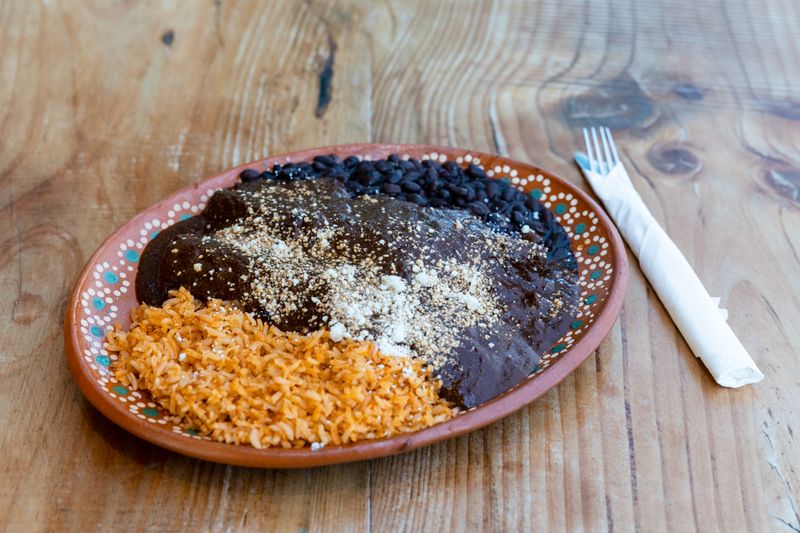
Mole is not one sauce but a large family of sauces from Mexico, built on combinations of dried chiles, spices, nuts or seeds, and often a long list of other ingredients that vary by region, household, and occasion. The word itself comes from the Nahuatl molli, meaning sauce or mixture, which is a useful reminder that "mole" describes a category of technique and flavor-building rather than a single fixed dish. This guide gives an overview of what the major mole families have in common, where they differ, and why a proper mole takes real time to make — useful context before attempting even a simplified home version.
Mole as a family of sauces, not one recipe
Dozens of named moles exist across Mexico, varying by region and even by individual family, each with its own combination of chiles, spices, and other ingredients. What unites them is a technique: dried chiles are rehydrated and blended with other aromatics and thickening ingredients into a sauce that is simmered, often for hours, until the flavors meld into something deeper than the sum of its parts. Treating "mole" as a single dish — usually meaning the chocolate-tinted mole poblano most familiar outside Mexico — understates the diversity of a tradition that includes bright green moles, dark near-black ones, and simpler yellow and red versions, each suited to different dishes and occasions.
The building blocks: chiles, spices, nuts, seeds, and sometimes chocolate
Most mole recipes start with two or more varieties of dried chile, chosen for different qualities — some for fruitiness, some for smokiness, some mainly for color and body. Toasted spices such as cinnamon, cloves, and black pepper are common additions, along with nuts or seeds like almonds, peanuts, pumpkin seeds, or sesame seeds, which add richness and help thicken the sauce once blended. Some mole families include a small amount of chocolate or unsweetened cacao, which adds bitterness and depth rather than functioning as a dessert flavor; it is one ingredient among many, not the sauce's defining feature, even though it tends to get outsized attention from people encountering mole poblano for the first time.
Mole poblano and the chocolate misconception
Mole poblano, from the state of Puebla, is the version most widely known outside Mexico, and it does typically include a small amount of chocolate alongside a long list of chiles, nuts, seeds, and spices. That chocolate functions the way chocolate does in some savory cooking traditions elsewhere — as a source of bitterness and complexity, balanced against the chiles and spices rather than tasting sweet or dessert-like in the finished sauce. Describing all mole as "the chocolate sauce" misrepresents both mole poblano, where chocolate is a supporting ingredient among dozens, and the wider mole tradition, where many well-known versions contain no chocolate at all.
Other regional mole families
Oaxaca is often described as having seven distinct mole traditions, usually distinguished partly by color: mole negro, a dark, intensely flavored version with charred chiles and often a touch of chocolate; mole verde, built on fresh herbs and green chiles or tomatillos rather than dried red chiles; mole amarillo, a lighter, yellow version using yellow chiles and less of the spice complexity found in darker moles; and mole colorado or rojo, built primarily on red chiles with a more direct chile flavor. Each of these serves a different role at the table, and none is a simplified or lesser version of another — they are distinct sauces with their own ingredient logic.
Why mole takes so long to make traditionally
A traditional mole involves toasting and rehydrating multiple dried chiles, toasting spices and seeds separately so each develops its own flavor before blending, and then simmering the combined sauce for an extended period to let the ingredients meld and the sauce reduce to the right consistency. This is genuinely a labor-intensive process, often reserved for special occasions and sometimes made collaboratively within a household or community precisely because of the time and ingredient list involved. That complexity is part of what makes mole significant in Mexican culinary tradition, not an inefficiency to be engineered away.
Dried chile selection and preparation
Different dried chiles contribute different qualities: ancho chiles are mild and fruity, mulato chiles add a raisin-like sweetness, pasilla chiles bring a deeper, slightly bitter note, and chipotle or morita chiles add smokiness. Chiles are typically stemmed and seeded, toasted briefly in a dry pan to wake up their oils without scorching them, then soaked in hot water until pliable enough to blend smoothly. Using only one type of chile, or skipping the toasting step, produces a flatter, less layered sauce than combining several with distinct roles.
Building a simplified home version
A home cook without a full day to devote to mole can still build a reasonable simplified version using two or three dried chiles, a modest spice list, and a shorter simmer, understanding that the result is a home interpretation rather than a faithful recreation of a specific regional mole, which typically reflects generations of household technique. Approaching it this way — as a starting point for learning the technique rather than a substitute for the tradition it draws on — keeps expectations realistic and the result genuinely enjoyable.
| Mole family | Typical color | Key ingredients |
|---|---|---|
| Mole poblano | Reddish-brown | Multiple chiles, spices, small amount of chocolate |
| Mole negro | Dark, near-black | Charred chiles, often chocolate |
| Mole verde | Green | Fresh herbs, tomatillos, green chiles |
| Mole amarillo | Yellow | Yellow chiles, lighter spice profile |
Common mistakes
- Assuming all mole contains chocolate, which overlooks major mole families like verde and amarillo that use none.
- Skipping the toasting step for chiles and spices, which leaves the sauce tasting flat and underdeveloped.
- Using a single chile variety, which produces a one-note sauce instead of the layered flavor multiple chiles provide.
- Rushing the simmer time, which keeps the ingredients tasting separate rather than melded into a cohesive sauce.
Frequently asked questions
- Does mole always contain chocolate?
- No. Some well-known families, like mole verde and mole amarillo, typically contain no chocolate at all; others, like mole poblano and some versions of mole negro, use a small amount.
- Is mole spicy?
- It varies by recipe and by which chiles are used. Many moles are more about depth and complexity than heat, though some can be quite spicy depending on the chiles chosen.
- Can mole be made in less than a day?
- A simplified version with fewer chiles and a shorter simmer is possible at home, though it will differ from a traditional version made with the full ingredient list and longer cooking time.
- What is mole traditionally served with?
- It varies by region and occasion, but common pairings include chicken, turkey, and tamales, often reserved for celebrations and special gatherings.
Sources: documented culinary history sources on regional Mexican sauce traditions; published culinary technique references on dried chile preparation and sauce reduction.